
Rikenda · Chronic Disease · Opinion
Hypertension Is Not a Disease of Old Age
It Is a Disease of How We Live
A field-based argument about metabolic health, systemic gaps, and what it will take to keep hypertension from becoming a permanent, preventable burden.
A silent epidemic is rising across Nigeria and the developing world — driven not by ageing populations, but by changing lifestyles, metabolic disruption, and health systems that were never built to respond. If we do not act differently, hypertension in low-resource settings risks becoming what infectious diseases once were: a permanent, largely preventable burden that exists because no one built the infrastructure to stop it.
This piece grew out of something we observed during a community health outreach in 2024. We met young adults — many in their thirties — with blood pressure readings that should have been caught and managed months prior. One needed medication urgently, on the spot. What struck us was not the severity of the readings, but how ordinary the situation was: not a crisis that came from nowhere, but a slow accumulation with no system in place to interrupt it. That observation sits behind the argument that follows.
A Crisis Hiding in Plain Sight
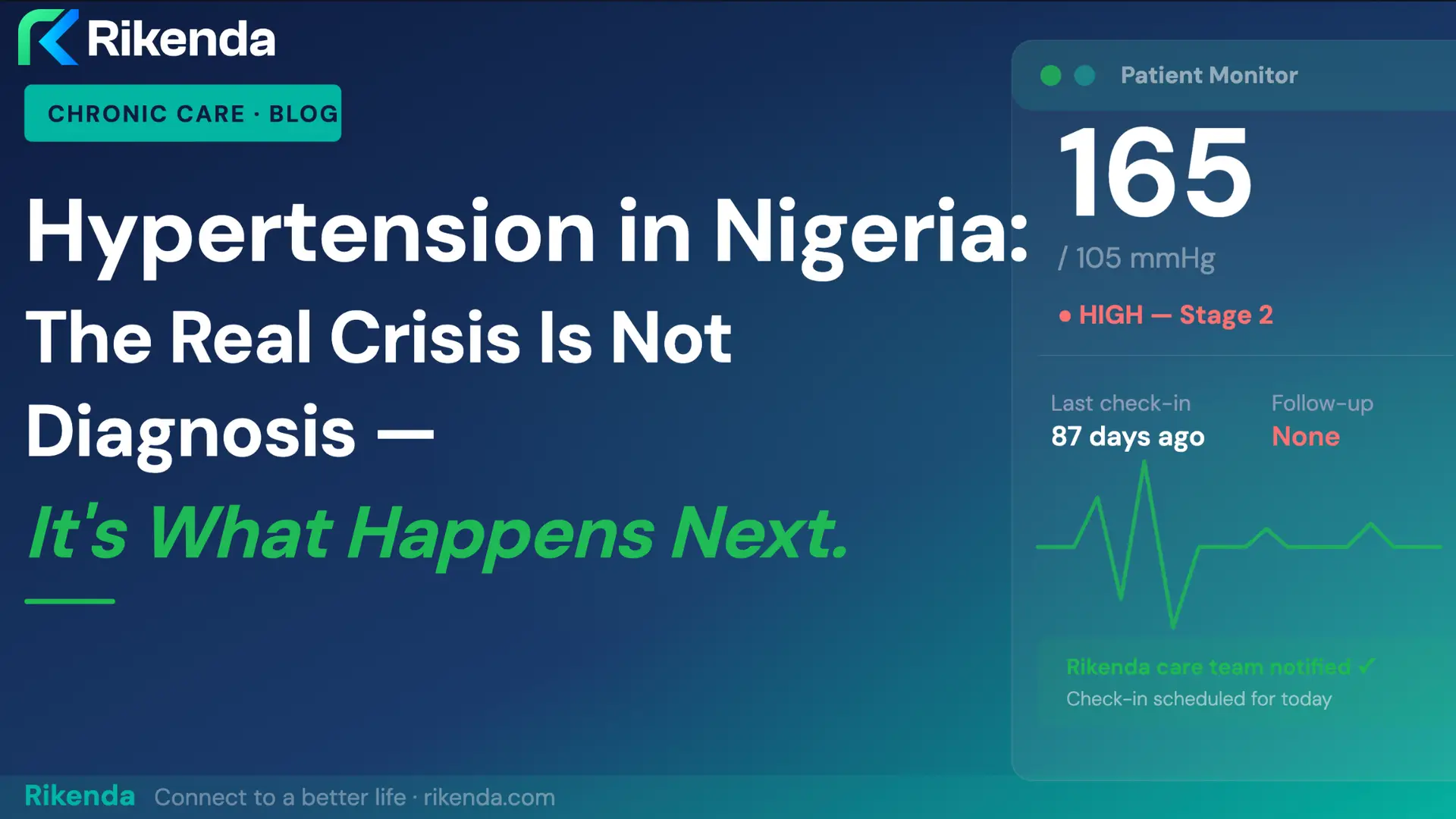
Roughly one in three adults in Nigeria lives with elevated blood pressure. Most do not know. Of those who do, fewer than 10% have it adequately controlled. These numbers describe not a niche health concern but one of the leading drivers of stroke, kidney failure, and premature cardiovascular death in the country — and the trajectory is worsening.
increase in hypertension-related deaths projected across sub-Saharan Africa by 2030 (WHO)
of cardiovascular deaths in low- and middle-income countries occur before age 70
This Is a Lifestyle Crisis, Not an Age Crisis
The assumption that hypertension is a disease of ageing is increasingly at odds with what is actually happening. We are seeing it present in people in their twenties, thirties, and forties — working-age adults, not the elderly. This is not coincidence. It reflects a metabolic shift driven by how modern life is now lived.
Poor metabolic health is the engine. When the body’s ability to process glucose and regulate insulin is disrupted — through sedentary behaviour, ultra-processed food, chronic stress, and poor sleep — blood pressure rises, arterial walls stiffen, and cardiovascular risk compounds silently over years. This is not primarily a genetic story. It is an environmental one: rapidly urbanising cities, energy-dense diets, diminishing physical activity, and rising psychological load.
Diet plays a role — including high sodium intake through seasoning cubes, cooking salt, and processed food — but it is one variable in a larger system. The deeper problem is metabolic dysfunction, and no single dietary intervention will address it alone.
The Infectious Disease Warning
There is a historical parallel that does not get made often enough. Tuberculosis, cholera, and polio were not eliminated in high-income countries primarily through individual behaviour change. They were controlled through systemic investment: infrastructure, sustained treatment protocols, community-level reach, and continuity over time. In low-resource settings, those same diseases persisted long after they had been controlled elsewhere — not because the science was missing, but because the systems were.
We are at risk of repeating this pattern with chronic disease. Hypertension is preventable and manageable. The science is not the obstacle. The obstacle is the absence of systems built to deliver prevention and continuous management at scale, in the communities where the disease is concentrated. Without that infrastructure, hypertension will linger — a permanent, largely preventable burden, disproportionately affecting the young and the working poor — while being largely resolved elsewhere.
In developed countries, hypertension is becoming a managed condition. In low-resource settings, without deliberate investment, it risks becoming endemic — a structural fixture, not a problem being solved.
The System Was Not Built for This
Healthcare infrastructure across sub-Saharan Africa was designed primarily to respond to acute and infectious illness — hospitals, outpatient clinics, episodic encounters. Hypertension requires something structurally different: community-level screening before symptoms appear, continuous monitoring, medication adherence support over months and years, and follow-up that does not require a patient to return to a clinic to receive it.
These elements are largely absent. Diagnosis happens. Prescriptions are issued. Then the patient re-enters daily life with no structure supporting them. This is not a failure of clinical skill — it is a design mismatch. The system is functioning as it was built. It is simply not built for the problem it now faces.
Chronic disease requires chronic infrastructure. Episodic systems produce episodic results — uncontrolled blood pressure, compounding damage, and preventable deaths.
The Response Has to Match the Problem
At Rikenda, we believe the gap is not primarily a knowledge gap — it is a continuity gap. People are diagnosed but not accompanied. Prescribed but not supported. The intervention needs to travel with the patient, not wait for them to return.
Nigeria is at a decision point. The knowledge exists. The models of care exist. The question is whether the investment in continuous, community-level infrastructure will be made before the burden becomes entrenched — or whether chronic disease will follow the same path that infectious disease did: solvable in principle, unresolved in practice, for decades.
Hypertension is not inevitable. It is a disease of how we live — and that means it can be changed.
About Rikenda
Rikenda is building continuous, preventive chronic care for people in Nigeria
and similar low-resource settings — care that accompanies patients between
clinic visits, not only during them.
Learn more at
rikenda.com
or reach us at
info.rikenda@gmail.com