
Rikenda · Field Insight · Nigeria · 2026
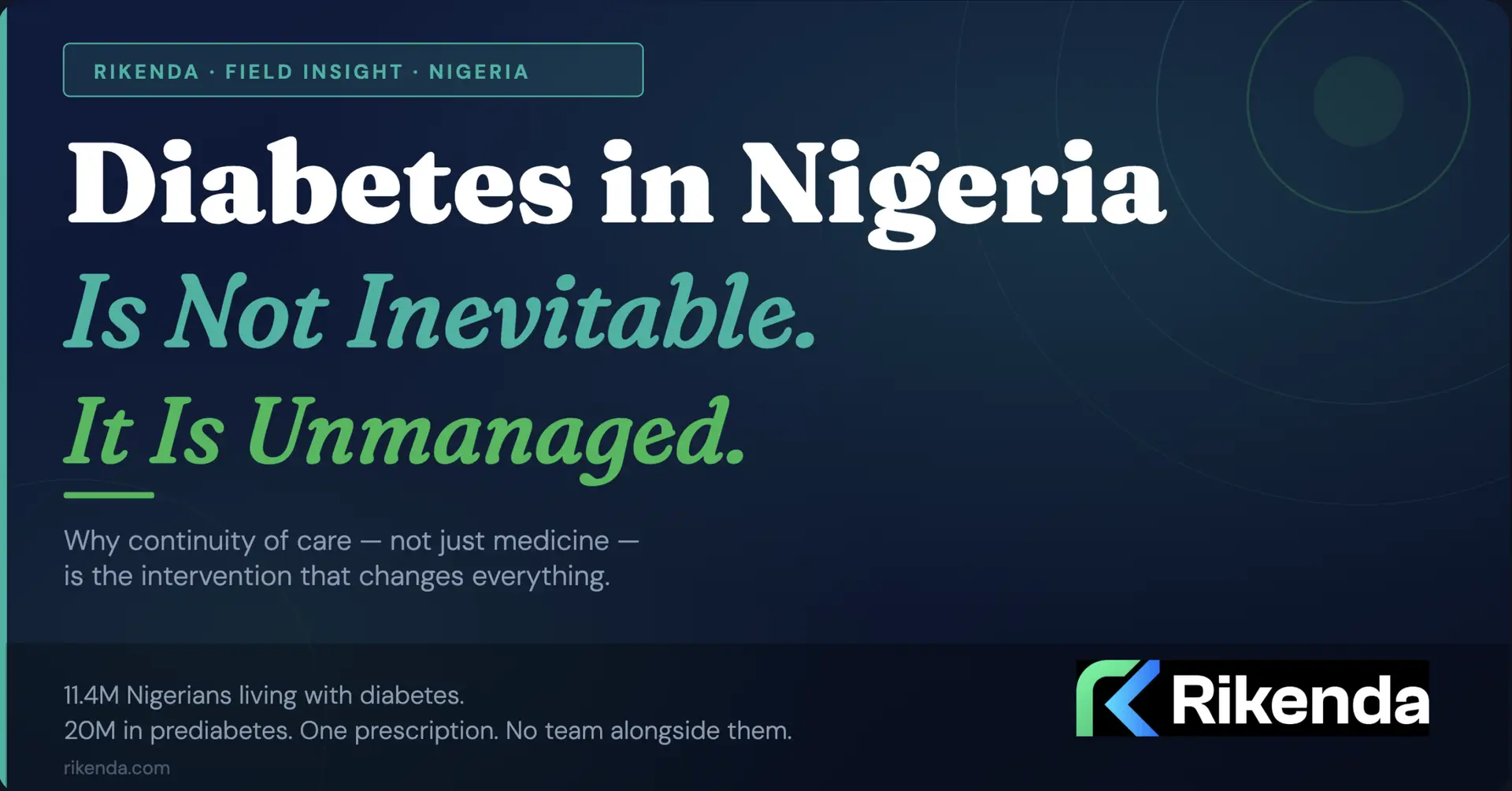
Diabetes in Nigeria
Is Not Inevitable.
It Is Unmanaged.
Why continuity of care — not just medicine — is the difference between a good outcome and a catastrophic one.
“Honestly, doctors have less than 10 minutes to explain diabetes or guide patients.”
— Senior Consultant, major Nigerian teaching hospital
That is not a complaint. That is a confession from inside the system — from a clinician who researches it, publishes about it, and still cannot fix it from where she sits. The Nigerian health system was built for acute crises. Arrive, treat, discharge. It was never designed for conditions that demand daily attention for the rest of a patient’s life.
The result: 11.4 million Nigerians are living with diabetes. Senior physicians believe the real number is closer to 22 million once undiagnosed cases are counted. And 20 million more are in prediabetes right now — most with no one walking alongside them.
The Crisis in Four Numbers
The Gap Is Not Medicine. It Is Structure.
In the United Kingdom, a person diagnosed with Type 2 diabetes has a named GP, a specialist pathway, a diabetes nurse, and an annual review. The system reaches for them. In developing systems like Nigeria, the system diagnoses — and then the majority of patients navigates alone. That structural gap explains almost everything in the table below.
| High-Income Countries | Nigeria / LMICs | |
|---|---|---|
| Glycaemic control | ~53% achieve target | ~37% achieve target |
| Undiagnosed rate | Lower (screening exists) | Up to 53.6% undiagnosed |
| Mortality trend | Stabilising | Projected +10–15% by 2030 |
| Care model | Multi-disciplinary team | Episodic clinic visits only |
| Management | Primary Health care | Loss of trust in PHCs |
The Lancet Commission’s 2025–2026 reframe makes this more urgent: Type 2 diabetes is primarily a condition of metabolic dysfunction, not simply weight or age. That means the traditional image of ‘diabetes as a disease of the overweight or elderly’ is dangerously wrong for Nigeria. The fastest-growing demographic for new diagnoses is now adults in their 30s and 40s. Working-age people. Parents. Breadwinners.
What We Need to Say Plainly
Diabetes is not an inheritance. It does not ‘run in the family’ the way eye colour does. Type 2 diabetes is a metabolic and lifestyle condition. The genetic predisposition is real, but it is not a sentence — it is a warning. We have become so accustomed to ‘sugar’ in our families that we have started to treat it as normal. It is not normal.
“For someone living with diabetes or prediabetes today, it is almost inconceivable to me that they would not do everything possible to get the best outcome. With the right support system, quality of life is good. Complications are not inevitable. They are the outcome of being left alone.”
The 2026 ADA Standards of Care now formally recognise what the evidence has long shown: digital coaching, AI-assisted monitoring, and community health worker teams are essential components of the care team — not optional extras. When patients are managed by a multi-disciplinary team, HbA1c levels drop by 1.3% more than in traditional siloed care. In Nigeria, community-based team support has already demonstrated a 23.5% improvement in medication adherence. The intervention that makes the difference is not a new drug. It is human accountability.
The Rikenda Position
Diabetes is a 24/7 disease. A doctor sees a patient for 15 minutes a year. The remaining 525,585 minutes are managed by the patient and their support system. Right now, most Nigerians are managing those minutes completely alone.
Rikenda exists to close that gap. A trained coordinator who knows the patient. An AI risk-banding engine that flags drift before it becomes decline. A doctor in the loop.
We are not replacing the doctor. We are not building another health app. We are solving the Human Accountability Gap — the dangerous silence between discharge and the next appointment. For Nigeria’s 20 million people in prediabetes, and the 11.4 million already diagnosed, the difference between a good outcome and a catastrophic one is not a new prescription. It is someone walking alongside them.